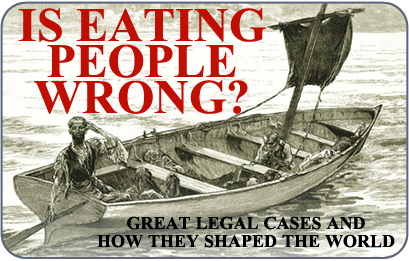
IS EATING PEOPLE WRONG?
SOME QUESTIONS TO CONSIDER
"Rather than view great cases as fixed stars or landmarks, I think it is more appropriate to think of them as temporary lighthouses, designed with a particular purpose in mind, constructed with available materials, and with a limited working life."
-- Allan C. Hutchinson
What is a "great case"? Why focus on the "great cases"?
What is the common law? What conclusions does Hutchinson reach about the basic character of the common law? How do you respond to his arguments?
How does Hutchinson distinguish between what he calls the "past-ists" and the "present-ists" as he identifies basic approaches to constitutional law? Where would you place Hutchinson here?
Is it possible for judges to honour the past without being imprisoned by it? What issues arise here?
What is the difference between "law" and "politics"? Is it possible to maintain this distinction in a politically-divided society? To what extent is it important that we do retain this distinction?
Why did Hutchinson write Is Eating People Wrong? What are the strengths and weaknesses of his book?
AUDIO AND VIDEO SOURCES
"Allan
Hutchinson: Shaping The Law,"
Agenda, TVO, May 20, 2011. REVIEWS AND ARTICLES
Ronald K. L. Collins, "Review Of 'Is Eating People Wrong?: Great Legal Cases And How They Shaped The World,'" Washington Independent Review Of Books.
"Allan C. Hutchinson On His Book Is 'Eating People Wrong?': Great Legal Cases And How They Shaped The World," Rorotoko (May 22, 2011).
Tracey Tyler, "Is
Eating People Wrong?,"
Toronto Star, January 28, 2011.